
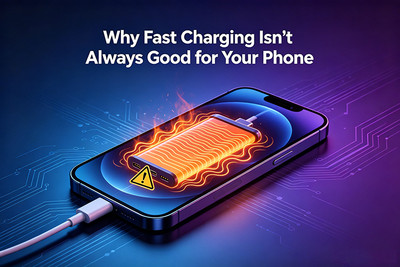
Why Fast Charging Isn’t Always Good for Your Phone
You've seen the ads. "50% charge in 15 minutes!" "Full battery in under an hour!" "Charge faster than ever before!"
It sounds like magic. And in many ways, it is—a triumph of electrical engineering that has transformed how we use our phones. But like many magical solutions, fast charging comes with a hidden cost that manufacturers don't advertise.
The uncomfortable truth? Every time you fast charge your phone, you're making a trade-off between convenience and long-term battery health.
This isn't a warning to avoid fast charging entirely. It's an education on how to use it wisely—so you can have speed when you need it and longevity when you don't.
What Actually Happens Inside Your Phone During Fast Charging
To understand why fast charging can be problematic, you first need to understand what's happening inside your battery.
The Chemistry of Charging
Your phone's lithium-ion battery works by shuttling lithium ions between two electrodes: the cathode and the anode. When you charge, ions flow from the cathode to the anode. When you discharge (use your phone), they flow back.
Normal charging is like a calm river. Ions flow steadily, gently, without disturbing the delicate structure of the electrodes.
Fast charging is like a flash flood. Ions are shoved through the electrolyte at high speed, under high pressure, generating significant heat and physical stress.
The Three Stressors of Fast Charging
| Stressor | What Happens | Long-Term Effect |
|---|---|---|
| Heat | Fast charging generates 10-20°F (5-10°C) more heat than standard charging | Heat is the #1 killer of lithium-ion batteries |
| High Voltage | Fast charging pushes voltage to the upper limit of the battery's tolerance | Accelerates chemical breakdown of the electrolyte |
| Physical Stress | Ions are forced into the anode faster than it can naturally accept them | Creates micro-cracks in the electrode structure |
These stressors don't kill your battery overnight. But over months and years, they accumulate. The result? A battery that degrades faster, holds less charge, and needs replacement sooner.
How Much Faster Does Fast Charging Degrade Your Battery?
| Charging Method | Charge Time (0-100%) | Battery Cycles to 80% Health | Lifespan Reduction |
|---|---|---|---|
| Slow charging (5W-10W) | 2.5-4 hours | 800-1000 cycles | Baseline |
| Standard charging (15W-20W) | 1.5-2 hours | 600-800 cycles | 20-30% reduction |
| Fast charging (25W-45W) | 45-75 minutes | 400-600 cycles | 40-50% reduction |
| Ultra-fast charging (65W+) | 20-35 minutes | 300-500 cycles | 50-60% reduction |
What this means in real terms:
A battery charged slowly every night might last 3-4 years before noticeably degrading.
The same battery fast-charged twice daily might need replacement in 18-24 months.
The Real Enemy of Battery Health: Heat
People often blame charging speed itself for battery damage.
In reality, the biggest problem is usually heat.
Lithium-ion batteries operate through chemical reactions. Those reactions become less stable when temperatures rise too high.
Fast charging generates heat because:
- Higher current flows through the battery
- Internal resistance creates thermal buildup
- Processors and screens may still be active during charging
- Thick cases can trap heat
- Wireless charging adds extra inefficiency
Excess heat accelerates battery degradation.
Over time, this can lead to:
- Reduced battery capacity
- Shorter daily battery life
- Slower performance
- Unexpected shutdowns
- Battery swelling in extreme cases
Most smartphone manufacturers know this, which is why modern devices include thermal management systems.
Your phone may automatically slow charging when temperatures climb too high.
That’s not a flaw.
It’s protection.
The Science of Battery Degradation: What's Actually Breaking
Let's get slightly technical—but stay accessible.
SEI Layer Growth (The Inevitable Aging Process)
Every lithium-ion battery naturally develops a Solid Electrolyte Interphase (SEI) layer on the anode. This layer is essential—it prevents unwanted chemical reactions. But it grows over time, and when it grows too thick, it reduces the battery's capacity.
Fast charging accelerates SEI growth. The high voltage and ion flow speed cause the SEI layer to form faster, thicker, and less uniformly.
Lithium Plating (The Fast-Charging Specific Danger)
This is the big one. When you force lithium ions into the anode faster than it can accept them, some ions plate out as metallic lithium on the anode surface instead of intercalating (inserting) into the anode structure.
Why this is bad:
- Metallic lithium is highly reactive and consumes electrolyte
- It creates physical protrusions called dendrites
- Dendrites can eventually pierce the separator and cause a short circuit (rare but dangerous)
Lithium plating is the primary reason manufacturers limit charging speeds. It's also why you should never fast charge a freezing-cold battery (plating risk increases at low temperatures).
How Different Manufacturers Handle Fast Charging (And What It Tells Us)
Not all fast charging is created equal. Different companies have different philosophies.
| Manufacturer | Max Speed | Strategy | What It Reveals |
|---|---|---|---|
| Apple | 27W-35W | Conservative, prioritizes battery health | Believes speed isn't worth the degradation |
| Samsung | 25W-45W | Balanced, with user controls | Offers speed but warns users |
| 23W-30W | Similar to Apple, health-focused | Slowest of the flagships | |
| OnePlus | 80W-100W | Aggressive with proprietary technology | Claims their dual-cell design minimizes heat |
| Xiaomi | 120W-200W | Extremely aggressive | Prioritizes marketing "wow factor" over longevity |
The Hidden Message
The companies that build their own phones and support them for years (Apple, Samsung, Google) are conservative with charging speeds.
The companies that prioritize specifications and quarterly sales figures are aggressive with charging speeds.
That's not a coincidence.
Should You Stop Using Fast Charging?
Not necessarily.
Fast charging exists because modern life demands convenience.
Most people:
- Travel constantly
- Use navigation apps
- Stream video
- Work remotely
- Depend heavily on smartphones
Waiting three hours for a full charge is unrealistic for many users.
The key is balance.
Using fast charging occasionally or when needed is unlikely to destroy your battery.
Problems usually come from constant heat exposure and aggressive charging habits over long periods.
Smarter Charging Habits That Help Battery Longevity
You don’t need to become obsessive about battery health.
Small changes can meaningfully reduce long-term wear.
Avoid Extreme Heat
Never leave your phone:
- In a hot car
- Under direct sunlight
- Under a pillow while charging
- On heat-trapping surfaces
Heat is one of the biggest battery killers.
Use Slower Charging Overnight
If you charge while sleeping, you probably don’t need maximum charging speed.
A slower charger can reduce heat and stress.
Don’t Constantly Drain to 0%
Keeping your battery between roughly 20% and 80% can reduce wear.
You don’t need perfection.
Just avoid extremes when possible.
Remove Thick Cases During Charging
Heavy-duty cases can trap heat.
If your phone gets warm while charging, removing the case may help cooling.
Use Certified Chargers
Cheap, low-quality chargers may lack proper voltage regulation and safety protections.
Using reputable chargers matters.
Enable Battery Protection Features
If your phone offers optimized charging or charging limits, consider turning them on.
These tools exist for a reason.
The Technology That's Changing the Game
Manufacturers aren't ignoring this problem. Several innovations are making fast charging safer.
1. Dual-Cell Batteries
Instead of one battery charging at high speed, some phones (OnePlus, Oppo) split the battery into two cells that charge simultaneously at lower individual speeds. This reduces heat and stress while maintaining fast total charging.
2. Advanced Charging Controllers
Modern phones use sophisticated power management ICs that:
- Monitor temperature in real-time
- Reduce charging speed when heat builds
- Learn your habits and optimize accordingly
3. Bypass Charging (Game-Changer)
Some gaming phones (ROG, RedMagic) offer "bypass charging"—powering the phone directly from the charger while leaving the battery idle. This eliminates battery stress during intensive use.
4. Optimized Battery Charging (Apple) / Adaptive Charging (Google / Samsung)
These features learn your routine. If you consistently charge overnight, they'll charge to 80% quickly, then wait to finish the last 20% just before you wake up. This minimizes time spent at high voltage (100%).
So, Is Fast Charging Bad?
The answer is nuanced.
Fast charging is not inherently dangerous.
Modern smartphones are designed with sophisticated protections:
- Temperature monitoring
- Smart charging algorithms
- Voltage regulation
- Thermal throttling
- Battery health management
But faster charging does generally create more heat and stress compared to slower charging.
Over months and years, that can contribute to faster battery degradation.
The impact depends on:
- Charging frequency
- Heat exposure
- Device quality
- Battery design
- Charging habits
- Environmental conditions
Using fast charging occasionally is unlikely to cause major problems.
Using ultra-fast charging constantly while your phone overheats regularly may shorten battery lifespan more noticeably.
The Final Verdict
Fast charging is one of the most useful smartphone innovations of the past decade.
It saves time, reduces battery anxiety, and makes modern devices far more practical.
But convenience always comes with trade-offs.
Batteries are consumable components.
Every charge cycle slowly wears them down, and excessive heat accelerates that process.
The good news is you don’t need to abandon fast charging entirely.
A few smarter habits — avoiding excessive heat, using optimized charging features, and relying on slower charging when time allows — can help preserve battery health without sacrificing convenience.
In the end, the goal isn’t charging your phone as fast as possible.
It’s keeping your phone reliable for as long as possible.
Recent Posts
-

30-Second Fix: How to Clean a Clogged Speaker Grill
Your phone's speaker used to be loud and clear. Now it sounds muffled, distorted, or barely audible. …Sep 10, 2026 -
How to Use UV Glue for OLED Screen Replacement: Complete DIY Guide
Replacing an OLED screen is one of the most rewarding smartphone repairs—but it's also one of the ea …Jul 17, 2026 -

Dead Pixels on Phone Screen: Can You Fix Them?
Have you noticed a tiny black dot on your phone screen that never changes color—no matter what app y …Jun 25, 2026